Direction: The line graph shows the time (in hours) taken by two pipes A and B to fill...
Texas Instruments aptitude question with a worked answer. Free to practise - no sign-up.
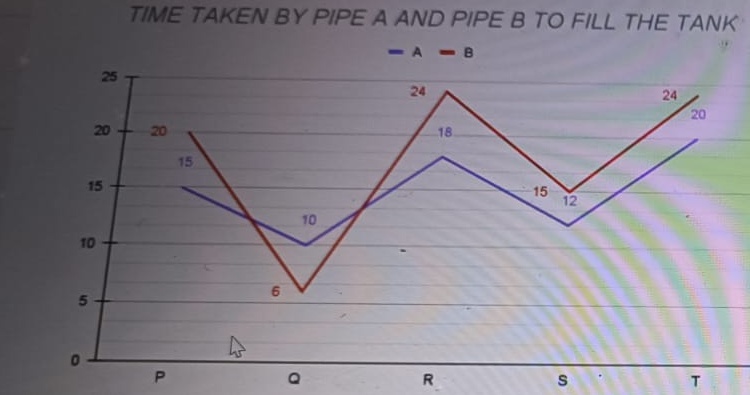
Direction:** The line graph shows the time (in hours) taken by two pipes A and B to fill tanks P, Q, R, S and T.
Question: Pipe D is included with pipes A and B to fill tank R. Pipes B and D are opened for one hour each, alternatively with pipe A. If pipe D alone can fill tank R in 36 hours, what will be the total time required to fill the tank?
Show answer & explanation
Answer: C. 11 hours
Read Values from Graph for Tank R**:
- Pipe A fills Tank R in $18\text{ hours} \implies R_A = \frac{1}{18}\text{ of tank/hour}$.
- Pipe B fills Tank R in $24\text{ hours} \implies R_B = \frac{1}{24}\text{ of tank/hour}$.
- Pipe D fills Tank R in $36\text{ hours} \implies R_D = \frac{1}{36}\text{ of tank/hour}$.
Normalize Work Units:
- $\text{LCM}(18, 24, 36) = 72\text{ units}$.
- Rate of Pipe A = $72 / 18 = 4\text{ units/hour}$.
- Rate of Pipe B = $72 / 24 = 3\text{ units/hour}$.
- Rate of Pipe D = $72 / 36 = 2\text{ units/hour}$.
Operational Schedule (2-Hour Cycle):
- 'Pipes B and D are opened for one hour each, alternatively with pipe A' means:
- Hour 1: Pipe A + Pipe B $\implies 4 + 3 = 7\text{ units}$.
- Hour 2: Pipe A + Pipe D $\implies 4 + 2 = 6\text{ units}$.
- Work done in one complete $2\text{-hour}$ cycle = $7 + 6 = 13\text{ units}$.
- 'Pipes B and D are opened for one hour each, alternatively with pipe A' means:
Calculate Total Duration:
- In $5$ cycles ($10\text{ hours}$): $5 \times 13 = 65\text{ units}$ are filled.
- Remaining volume to fill = $72 - 65 = 7\text{ units}$.
- In the $11\text{th hour}$, it is the turn of $(A + B)$, which fills exactly $7\text{ units/hour}$:
$$\text{Time for remaining 7 units} = \frac{7}{7} = 1\text{ hour}$$ - Total time required = $10 + 1 = \mathbf{11\text{ hours}}$.
Thus, the correct option is C.