The IV characteristics of an NMOS, as predicted by the standard equation of drain current I...
Texas Instruments technical mcq question with a worked answer. Free to practise - no sign-up.
The IV characteristics of an NMOS, as predicted by the standard equation of drain current $I_D$, are given in the following graph.
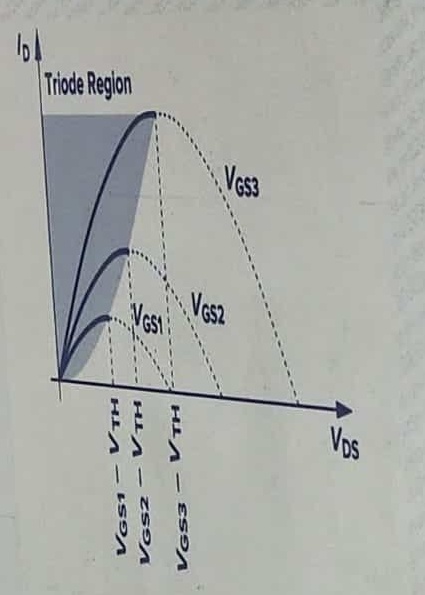
In reality, the drain current does not follow the parabolic behavior and $I_D$ becomes relatively constant, and we say the device operates in the "saturation" region. What could be a valid reason behind this?
Show answer & explanation
In the saturation region of an NMOS, the channel is 'pinched off' at the drain end. However, current continues to flow because the high electric field in the depletion region sweeps the electrons from the end of the channel into the drain terminal.
Step-by-step Derivation:
Step 1: Analyze the condition for pinch-off. In an NMOS, pinch-off occurs when the potential difference between the gate and the channel at the drain end ($V_{GD}$) equals the threshold voltage ($V_{TH}$). This happens when $V_{DS} = V_{GS} - V_{TH}$.
Step 2: Evaluate the state of the channel. When $V_{DS} > V_{GS} - V_{TH}$, the inversion layer (channel) no longer reaches the drain contact; it terminates at a distance from the drain.
Step 3: Determine the mechanism of current flow. Despite the absence of a continuous inversion layer, a strong lateral electric field exists in the depletion region between the pinch-off point and the drain terminal. Electrons arriving at the pinch-off point are accelerated by this field and 'shoot through' the depletion region to reach the drain.
Step 4: Compare with options. Option A is incorrect because the channel is physically pinched off. Option B is incorrect because the current is carried by majority carriers (electrons in NMOS), not minority carriers. Option C accurately describes the physical mechanism of current transport in the saturation region.